Showing posts with label Orthodoxy. Show all posts

03 April, 2010

Holy Friday Epitaphios

Photos from Holy Friday procession.

Epitaphios coming down the stairs.
Epitaphios

Epitaphios passing in front of me.
Epitaphios

I have to go to work tonight. I home to make it for Anastasi!

15 February, 2010

Kathari Deftera and Hartaetos

Today, 15 February 2010, was Clean Monday (Καθαρή Δευτέρα) for the Orthodox and holiday for the Greeks. From this day till Easter, the Orthodox are not supposed to eat meat, dairy and egg.

About the Greek customs for this day, I wrote about it last year, so I won't repeat IT.

This year we did not do anything particular, except for the traditional kite flying.

Kite is called hartaetos (χαρταετός) in Greek, meaning paper eagle.

Weather was very fine today and was relatively warm.


It was however quite windy. Many people were trying to fly their kites, but the wind was so strong that it was really difficult to take control of them.

But there were some able guys who were doing it right.

Kite flying

Hubby - inexperienced kite flyer - tried it for a while, but his kite disintegrated in 10 minutes or so.


To be honest, I was not enthusiastic about the prospect of kite flying and started to observe the Peiraiki restaurants. Although not many Greeks observe the Lenten diet any more, everyone - even the non-observers - is eager to eat squids, octopus, and shellfish on this day. For this reason, fish restaurants all over the Greece do great business on Clean Monday and the fish restaurants on Peiraiki coast are no exception.

I noticed two new restaurants opened.


These premises had been restaurants even before, but now they opened with different names: Εν λευκώ and Ανέμες.

Hubby, being a bad loser, wanted to buy another kite, but most of the shops were closed (obviously) and even the open ones had run out of it. Not that I felt pity. :)


24 August, 2009

New Entries: Lesvos and Monastery of Saint Rafael

Slowly I started to write about our recent trip to Lesvos Island.

Lesvos Island

and

Saint Rafael Monastery

Saint Rafael is a most interesting place to take a peek into the modern Greek religious mentality. What happened in late Antiquity is still happening in 21st century Greece!

14 April, 2009

Kyriaki ton Vaion (Palm Sunday)

This Sunday (12 April 2009) was Κυριακή των Βαΐων, Greek Orthodox Palm Sunday.

Hubby and I have been lazy to go to church in the morning recently, but we thought we should at least on this important festivity (the day Jesus entered Jerusalem, or so claimed - it is a movable feast as is Easter and cannot be an exact historical date).

To be honest, we arrived late (I have an excuse to have waited for Hubby to wake up and to finish his coffee!) and the church was full. As you can imagine there are numbers of people receiving communion. We didn't and got only Antidoron (pieces of bread at the end of service).

On the Kyriaki ton Vaion, people usually get laurel branches at the church, but the one we wend did not have ones to 'take away'.


We got this branch from my Mom-in-Law who went to another church.

During the Lenten period, there are two days we are allowed to eat fish and Ton Vaion is one of them (the other being Annunciation day - 25 March). I bought this fish from Laiki Market on Saturday.


Not that I bought only one. They are very small fish, about 10-12 centimetre long (my internet image search suggests that they can grow larger). It is called Μπάλας - Μπαλάδες) and evidently belong to bream family. They are nice pink and really beautiful. It is cheap fish; only 4 euros a kilo.

As they were small, I fried them (here is about half a kilo of balades).

They were delicious. Meat was tasty with a flakey texture of bream family. Only downside was that small bones were rather hard and sharp; it might have been better, if I cooked them longer.

After lunch, we went out to meet to friends and relatives in Marina Zea. Ritual of 4 hour coffee time; Greeks love it, but honestly it is too long for me.

07 March, 2009

Kathari Deftera

This Monday was Katheri Deutera (or Kathara Deutera), Clean Monday, national holiday for the Greeks. If this name reminded you about the dangerous Mediaeval heretics Cathars, you are linguistically on the right track: Cathars took their name from the Greek adjective for clean - katharos.

This day the Lenten season truly begins. Actually the week preceding to it was Tyrini week, meaning the Orthodox Christians should start fasting except for milk and milk product, but it looks that not many people observe this.

It was a very fine day. The first activity of the day for us was to go to buy lagana (λαγάνα), which is a flat bread with sesame seeds eaten typically on Clean Monday. We went to the neighbourhood bakery I often go. In front of the shop there was this mega lagana, but as it was broken into three, it did not have desired effect.


We bought our stuff and went down to the seaside. This is how the lagana looks like. This year the minimum price for lagana seems to have set at 2.50euro in Athens, but our bakery were selling it for 3euros. It was nice, but not as nice as Hubby had insisted it was.


We bought also half a kilo of kritsinia, kind of bread biscuits. They are all-season stuff, but people eat more during the fasting periods. This one is multi-seeds variety that I like the best.


There were people flying their kites: this is one of the typical things to do on Clean Monday. This hexagonal one is the most typical Greek kite.

These guys had a kite shaped like eagle. Kite is called hartaetos (paper eagle) in Greek.


Then we went to Hubby's parents' house for lunch. Hubby cut lagana into pieces. This lagana is larger than ours.


The main dish was fried karamari. On Katheri Deftera, the Greeks eat kalamari (squids or cuttle fish), octopus, and/or prawns/shrimps. The streets were filled with the smell of frying or grilling these.

On the table there was a halvas - sesame based sweet, again, typically eaten during the Lenten period. I don't like very much sesame halvas and prefer semolina halvas, again typical sweet of the period.


Then we went for coffee with friends and had coffee without milk. There was quite a lot of people abstaining from milk in the cafeteria.

At home, the dinner was octopus. This is one of they typical way the Greeks eat their octopus during the Lent. Octopus is slowly stewed with tomato and when softened, cooked with short tube-shape pasta.


The octopus was soooo good: it was tender and flavourful. It was actually too good for the Lenten table. Some people remove oil from their food. Maybe it is the only way to make the octopus unpalatable.

23 February, 2009

Goodbye Meat + Correction

On the Thursday last week, Tsiknopempti, I wrote that it was the last day we are allowed, according to the Orthodox tradition, to eat meat before Easter.

I was wrong.

It is actually from today (23 Feb. 2009, Monday) we are not supposed to eat meat, yesterday being the Meatfare Sunday (Kyriaki tis Apokreo). This week is Cheesefare Week and after Cheesefare Sunday (Tyrini), no more dairy until Easter, according to the rule book.

Hubby claims the fasting does not start until Katharideutera (Clean Monday), so I will cook as he likes. I am not convinced by the Orthodox fasting practice and will do in my own way.

I did do it once for full Lenten period, but could not feel the benefit of it. I cannot agree that the Lenten diet is good for health or that shrimps, prawns, octopus, or shellfish are not animal. I never understand why fish eggs are allowed, while fish are not.

Mum-in-Law says that there is no use in doing fasting, if, while not eating the prehibited food, one does not eat in moderation. It is true. During the fasting period, it is difficult to control the quantity of food intake, as one cannot easily satisfied with the allowed food and ends up in eating more.

Let's see how it goes.

19 February, 2009

Tsiknopempti Today

It is Tsiknopempti today; the last day the Greek Orthodox believers are allowed to eat meat before the Easter.

The word Tsiknopempti is a composite of tsikna (smell arising from meat grilling) and pempti (Thursday). As from next Monday the Orthodox Christians are not allowed to eat meat, I guess they celebrate the day grilling the meat.

I still don't know how much proportion of the modern day Greeks observe the Orthodox fasting to the word. My impression is that not a few observe it only the first and the last week of the Lent, but I don't know many, except, of course, the priests, do it to the full.

Hubby says he will do it, but I predict he is going to make some exceptions, like milk in his coffee in the morning or on party occasions. I am not fully convinced by the philosophy of the Orthodox fasting and will do it in my own way. The Church says the believers should follow exactly what the rule book tells us and otherwise there will not be any benefit. But, you know, the Church would OF COURSE say so.

This is the first time for me to be able to observe how the Greeks observe the period before Easter and I am very much looking forward to it.

10 March, 2006

Ag. Eleftherios and Panagia Gorgoepikoos Church in Athens

   Ag. Eleftherios and Panagia Gorgoepikoos church is a small Byzantine church, situated next to the Metropolitan cathedral of Athens. I added several new photos to the preexisting page.
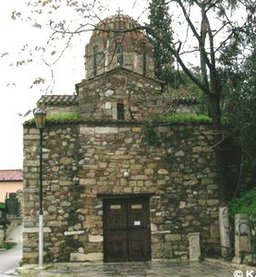
http://www.mesogeia.net/athens/places/byzantineathens/mitropolistop_en.html

Remarkable is the mixture of Classic and Early Byzantine spolia, inserted into this small middle Byzantine church. Everytime I go there, I cannot stop admiring its eccentric beauty.

03 March, 2006

Holy Apostles Church in Athenian Agora


I added five new photos to the page on the Church of Holy Apostles in the Agora of Athens. Formally there were only two photos.

http://www.mesogeia.net/athens/places/byzantineathens/holyapostoles_en.html

This is the oldest church (early 11th century) that remains in Athens which does not have early Christian basilica. Reason being that in the Early Christian period, the Athenian often reused the old temples as church, like Parthenon and Hephaisteion. The new churches were surely build, like the one in the Hadrian's Library, but any one of these is standing now.

Metamorphosis (Sotiros) Church in Athens


A page on the Metamorphosis Church in Upper Plaka was added.

http://www.mesogeia.net/athens/places/byzantineathens/sotiraki_en.html

This small Byzantine church, built between the end of the 11th and the early 12th century, is also called Sotir Church or Sotiros Church, in contrast to the other Metamorphosis Church (Kottakis Church) in Lower Plaka.